
Before my internship with the Partnership for Public Service, like most people, I rarely thought about the federal government’s role in disaster preparedness.
But it turns out there’s a lot that happens behind the scenes in federal agencies to protect families and essential infrastructure before disasters hit.
For example, the Federal Emergency Management Agency’s Building Resilient Infrastructure and Communities program, or BRIC, funds projects such as building levees and flood barriers and making drainage improvements to reduce the risk and impact of future disasters.
Since 2020, states, tribal nations and local governments have used this program to invest in infrastructure designed to withstand future natural disasters. These investments not only protect communities but are also intended to save money in the long run. According to the National Institute of Building Sciences, every dollar invested in mitigation saves $6 in future recovery costs.
Local impact of federal cuts on community resilience
However, in April 2025, FEMA canceled the BRIC program, halting new applications and disrupting projects that communities had spent years planning to better protect lives and property.
In Washington state, approximately $182 million had been approved for 27 flood mitigation projects in 2025. These investments would have funded levels and raised roadways and other improvements, including an $18.8 million effort to elevate or purchase homes in flood-prone areas and transform surrounding land into an open space capable of absorbing floodwater.
As projects were delayed, placed on hold or canceled, resources intended to reduce future disaster risks for communities across the U.S. were stuck in limbo. These disruptions drew bipartisan criticism and legal challenges from 22 states, and on December 2025, a federal judge ruled that the FEMA’S termination of BRIC was unlawful.
BRIC programs reopened in April 2026 with $1 billion of available funding. However, communities seeking support were required to submit new applications and revisit previously planned projects.
The challenges faced by communities in Texas that experienced recent flooding further underscore the importance of investing in disaster resilience, as does the loss of BRIC funding for Scranton, Pennsylvania, and surrounding Lackawanna County.
For example, a portion of BRIC funding would have paid 75% of the cost of buying and demolishing 18 flood-damaged homes, helping residents recover from Hurricane Helene and reducing the risk of future flooding.
Federal workforce cuts exacerbate the problem
These examples extend beyond individual projects and reveal how closely communities depend on a strong federal workforce.
Recent reductions in funding and staffing have weakened emergency preparedness efforts in areas such as weather forecasting and scientific research.
Between September 2024 and February 2026, the federal workforce supporting emergency response and weather forecasting was cut by more than 14%, leaving fewer experts available to collect data, conduct research and provide critical warnings before severe weather strikes.
At the same time, agencies working in the emergency response and weather forecasting space saw a 30% decrease in research and development contract funding in fiscal year 2025, limiting innovation and the tools needed to strengthen preparedness.
What I have learned is that government is much more than policies and politics—it is also about the people whose work protects communities every day, often in ways most Americans never see.
An effective government is essential to keeping communities safe and strengthening local economies. When we weaken the federal workforce and reduce investments in science, preparedness and health research, communities across the country feel the consequences, affecting the safety and well-being of all Americans.
To learn more about how these federal cuts impact you and your community, visit the Partnership’s Cost of Cutting American Science product.
Author: Ana Berrios Pérez
Photo credit: FEMA Media Library
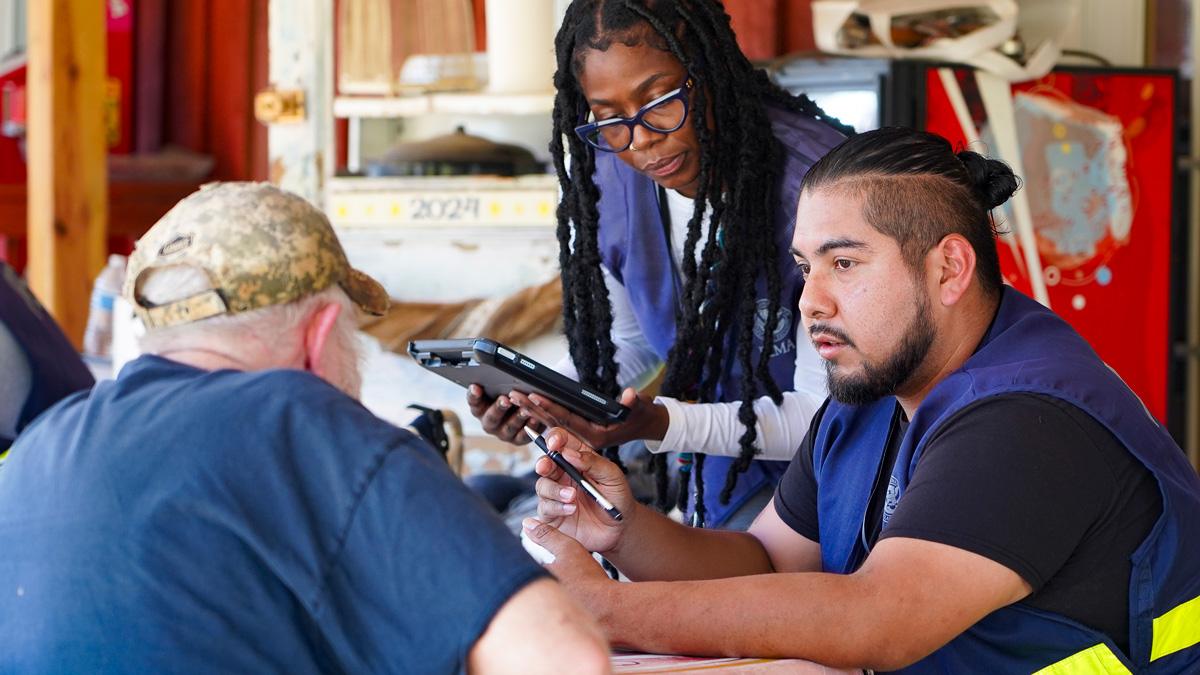
Jonesborough, Tenn. (Oct. 22, 2024) – FEMA Disaster Survivor Assistance teams assist survivors of Tropical Storm Helene in their recovery efforts at Fender’s Farm. (FEMA Photo by Robert Kaufmann/Released)