
When you hear the words “federal funding,” you might think of needless spending or bureaucratic waste, but investments by our government serve as a critical lifeline that builds local communities, feeds and houses the needy, drives groundbreaking scientific research, supports community violence intervention programs and so much more.
What happens when federal funding is taken away?
Since the start of the second Trump administration, $113 billion in federal grants and assistance have been canceled, creating a dire situation for community organizations, researchers and others who depended on the government support.
In New Mexico, waiting time to get a bed at Consuelo’s Place, a homeless shelter for vulnerable individuals transitioning into permanent housing, has increased because of funding cuts by the Department of Housing and Urban Development.
Cuts to scientific research grants administered by the National Institutes of Health left Massachusetts researchers looking into early detection of Alzheimer’s disease and Ohio researchers trying to find what causes endometriosis without funding.
In Illinois, a $5.6 million grant from the Department of Education dedicated to providing free mental health care for elementary, middle and high school students was terminated.
Who administers, processes and supports federal grants?
Funding is just a part of the story. Hundreds of thousands of federal employees across the country lost their jobs due to the administration’s policies, creating personal hardships while affecting the government’s ability to effectively serve the public.
After personnel reductions at the Department of Agriculture’s Animal and Plant Health Inspection Service, for example, a screwworm outbreak went undetected for longer than it should have, impacting American farmers and their finances.
Our national parks are struggling too. The National Park Service staff decreased by more than 8,000 employees in front-line and back-office jobs from September 2024 to February 2026, leaving parks short-handed in everything from visitor services to performing crucial air quality research. National park employees help protect our public lands and keep them beautiful, but the staffing cutbacks have put the parks at risk.
While the public generally associates federal employees with nation’s capital, 86.8% of the federal workforce is located outside of the Washington, D.C., metropolitan area. These employees perform numerous tasks to serve the public interest in ways one might not even think of, like protecting our energy grid or ensuring our veterans have health care, and all have been affected by the administration’s policies.
What is the impact of federal workforce cuts and grant terminations on the economy?
Federal spending has a significant impact on the nation’s economy, including scientific research where every dollar in grant funding results in an estimated $2.56 in economic benefits.
The Partnership found that, all told, the administration’s funding cuts that it described as “unnecessary spending” ended up costing the economy almost $91 billion, or $563.08 per U.S. taxpayer that could have been spent on helping the public and improving our communities.
Why does this matter and what can I do about it?
While a smaller federal government may be a reasonable goal, it should not come at the expense of families, communities and individuals just trying to support each other and create a healthier, stronger and more prosperous nation. The examples in this blog are just a snippet of the impact these cuts and disruptions have had on work being done across the country.
If any of this resonates with you, or you want to learn more about how your state and community are being affected, explore the Federal Harms Tracker to understand the impact these cuts are having on science, our government, our economy and our communities. Share information about the harms being done by these cuts and workforce reductions with your friends, neighbors and loved ones.
Author: Beck Barrett
Beck Barrett is a communications professional who uses storytelling to help the public understand complex ideas.
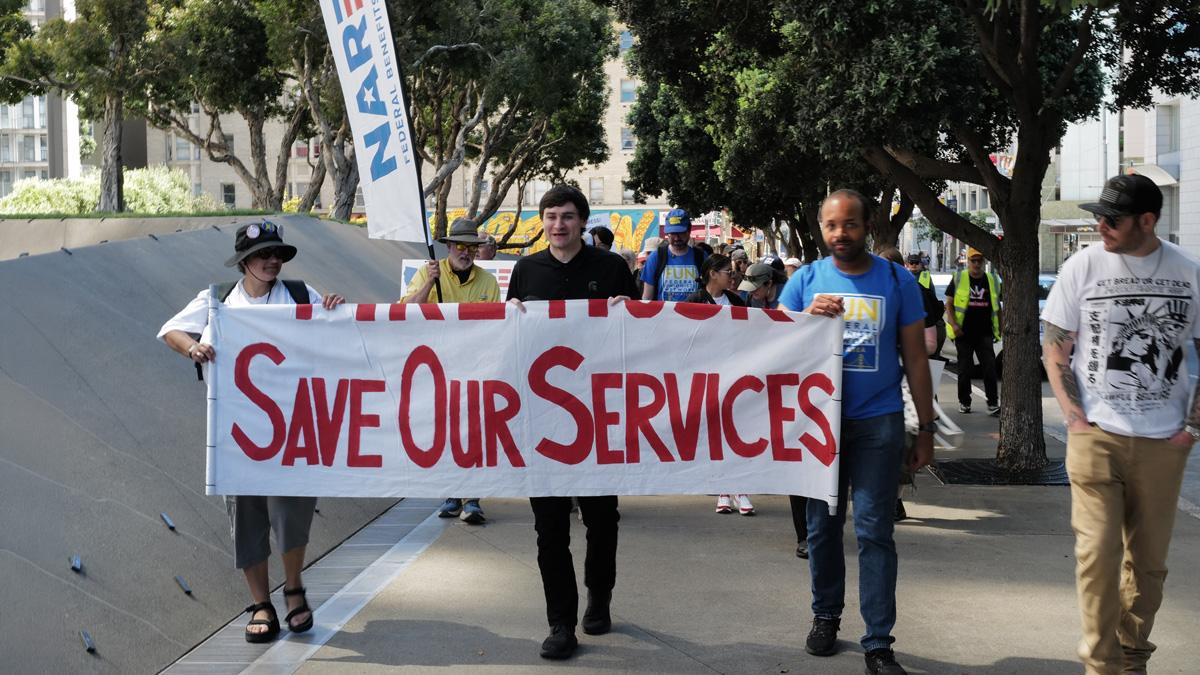
Featured image: Phil Pasquini / Shutterstock.com. Federal workers and activists rally Sept. 7, 2026, at the Phillip Burton Federal Building in San Francisco in support of federal employees fired by the Department of Government Efficiency.