
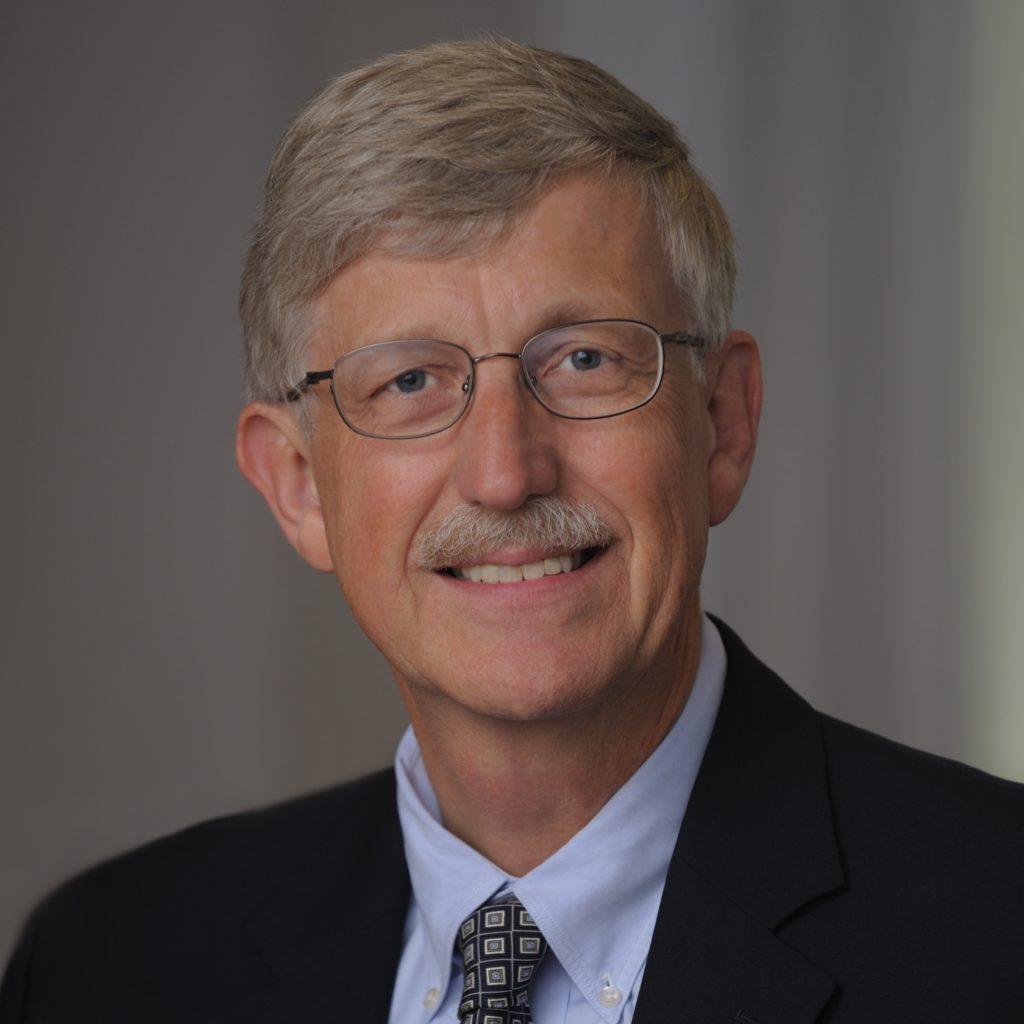
Francis Collins: A commitment to public good, public health and public service leadership
In the 1980s, a young scientist at the University of Michigan was working to identify the gene that causes cystic fibrosis, an inherited disease that researchers had been investigating for years.
Hitting roadblock after roadblock, the scientist was faced with a choice: go it alone and hope eventually to take credit for a discovery—or join forces with others competing for the same recognition.
He chose the latter, pitching a collaborative effort with Dr. Lap-Chee Tsui at the Hospital for Sick Children in Toronto. Combining their labs, Tsui and the scientist identified the gene two years later, a landmark discovery that laid the groundwork for future advancements in the treatment of cystic fibrosis and marked one of the first times the genetic basis for an inherited disease had been found.
That scientist was none other than Dr. Francis Collins, one of the nation’s foremost public servants who has left an indelible mark on global medicine in roles ranging from leader of the Human Genome Project to director of the National Institutes of Health to science advisor to the president.
Collins’ work on cystic fibrosis foreshadowed his approach to solving other pressing health challenges: a willingness to collaborate and engage others; a strong self-awareness with a unique blend of academic and emotional intelligence; a desire to lead change by taking calculated risks; and a steadfast focus on achieving results for individual patients.
Throughout his four-decade career, Collins has leveraged all of these leadership competencies to serve the public good and improve the well-being of current and future generations worldwide.
“I did not enter government as a public servant to add more entries to my CV about a committee I served on or a project I led. I became a public servant to give myself in every way that I can to advance the cause of human health for the benefit of humanity,” Collins said.

“The path of least resistance”
The irony is that Collins almost didn’t make the jump from academic medicine to public service.
Content with leaving his mark as a professor of internal medicine and human genetics at the University of Michigan, he initially balked at the opportunity to lead the Human Genome Project—a sweeping initiative that aimed to map and sequence all the genes of the human race—when offered the role by former NIH Director Bernadine Healy.
At the time, Collins had only run research labs and found the prospect of managing the “largest big science project ever in biology and medicine” daunting.
Still, he found himself uneasy about declining Healy’s offer, wary that he would later regret the decision to pass on such a unique public service opportunity.
“What worried me was that I was taking the path of least resistance by staying at Michigan and potentially passing up something that would allow me to make a much greater contribution to the country, to the world and to human health,” he said. Three months after telling Dr. Healy “no,” he said “yes.”
Engaging Others
When Collins began work on the Human Genome Project, he faced the management challenge of a lifetime: the need to recruit thousands of scientists in both the U.S. and overseas, build consensus on goals and standards for their work, and set a timetable for delivering findings and results.
“I floundered quite a bit for the first few years trying to figure out how to organize this effort,” he said.
Collins overcame these challenges by employing the same strategy he used to make a breakthrough on cystic fibrosis—he practiced an egoless and inclusive leadership style that prioritized collaboration and relationship-building to bring some of the world’s best and brightest scientists on board and propel the project.
Collins said a major key was respecting others’ expertise and being self-assured enough to “give them the permission to shine and to tell me when I was wrong.”
“It would have been harmful as a leader to send a message that everybody has to just do what I say,” he said.
Ultimately, more than 2,000 scientists working in six countries mapped the full genetic blueprint for a human being, identifying over 20,000 genes and sequencing 92% of the human genome in 2003. The work continues to provide researchers and health care providers with a wealth of new information to diagnose, treat, prevent and cure diseases associated with certain genes.
For Collins, the key lesson is that engaging others to meet common goals often outweighs the benefits of taking sole credit for a scientific discovery.
“Rather than say, ‘I’m the one who did it all by myself,’ I got to build relationships and experience science in a much more inspired way. Pretty much everything I’ve done ever since has involved looking for partners and for people who had the skills and visions to make things happen that otherwise would take a really long time,” he said.
Collins incorporated those same views into his twelve years as NIH director. Indeed, during the COVID-19 pandemic, Collins tapped into relationships he had built over the years with research and development leaders as well as the heads of major pharmaceutical companies to launch Accelerating COVID-19 Therapeutic Interventions and Vaccines, a public-private partnership aimed at developing promising coronavirus treatments and vaccines.
Collins called the group “the most amazing partnership I’ve ever been part of” and a core driver of the federal efforts to develop safe and effective COVID-19 vaccines.
Despite the demands of the pandemic—with staff working around-the-clock to develop new tests, treatments and vaccines, and Collins reportedly working 100-hour weeks at times—employee satisfaction and morale at the NIH held steady.
According to the 2020 Best Places to Work in the Federal Government® rankings, the agency placed 63rd out of 411 agency subcomponents, with its highest mark coming in the “Effective Leadership: Senior Leaders” category.
During his tenure, the NIH also had nearly 30 finalists—12 of whom were winners—recognized at the Partnership’s annual Service to America Medals® gala, the nation’s preeminent awards program for federal employees.
Collins attributes some of his leadership successes to self-care and maintaining healthy outlets to decompress. When not leading medical breakthroughs or combatting the pandemic, he can be found playing guitar in his rock ‘n’ roll band or riding bikes with his wife, Diane Baker, a leader in genetics counseling. He also stayed centered and grounded through his faith, starting most days with prayer and some Bible reading.
Overall, Collins fostered a culture of excellence at the NIH that enabled the agency to face adversity and mount a speedy and effective response to the pandemic.
“I will not forget being told, as the results were being unblinded for the phase three trial for the COVID-19 vaccine, that it was 95% effective. It was just like such an answer to prayer,” he said.
Engaging Others
When Collins began work on the Human Genome Project, he faced the management challenge of a lifetime: the need to recruit thousands of scientists in both the U.S. and overseas, build consensus on goals and standards for their work, and set a timetable for delivering findings and results.
“I floundered quite a bit for the first few years trying to figure out how to organize this effort,” he said.
Collins overcame these challenges by employing the same strategy he used to make a breakthrough on cystic fibrosis—he practiced an egoless and inclusive leadership style that prioritized collaboration and relationship-building to bring some of the world’s best and brightest scientists on board and propel the project.
Collins said a major key was respecting others’ expertise and being self-assured enough to “give them the permission to shine and to tell me when I was wrong.”
“It would have been harmful as a leader to send a message that everybody has to just do what I say,” he said.
Ultimately, more than 2,000 scientists working in six countries mapped the full genetic blueprint for a human being, identifying over 20,000 genes and sequencing 92% of the human genome in 2003. The work continues to provide researchers and health care providers with a wealth of new information to diagnose, treat, prevent and cure diseases associated with certain genes.
For Collins, the key lesson is that engaging others to meet common goals often outweighs the benefits of taking sole credit for a scientific discovery.
“Rather than say, ‘I’m the one who did it all by myself,’ I got to build relationships and experience science in a much more inspired way. Pretty much everything I’ve done ever since has involved looking for partners and for people who had the skills and visions to make things happen that otherwise would take a really long time,” he said.
Collins incorporated those same views into his twelve years as NIH director. Indeed, during the COVID-19 pandemic, Collins tapped into relationships he had built over the years with research and development leaders as well as the heads of major pharmaceutical companies to launch Accelerating COVID-19 Therapeutic Interventions and Vaccines, a public-private partnership aimed at developing promising coronavirus treatments and vaccines.
Collins called the group “the most amazing partnership I’ve ever been part of” and a core driver of the federal efforts to develop safe and effective COVID-19 vaccines.
Despite the demands of the pandemic—with staff working around-the-clock to develop new tests, treatments and vaccines, and Collins reportedly working 100-hour weeks at times—employee satisfaction and morale at the NIH held steady.
According to the 2020 Best Places to Work in the Federal Government® rankings, the agency placed 63rd out of 411 agency subcomponents, with its highest mark coming in the “Effective Leadership: Senior Leaders” category.
During his tenure, the NIH also had nearly 30 finalists—12 of whom were winners—recognized at the Partnership’s annual Service to America Medals® gala, the nation’s preeminent awards program for federal employees.
Collins attributes some of his leadership successes to self-care and maintaining healthy outlets to decompress. When not leading medical breakthroughs or combatting the pandemic, he can be found playing guitar in his rock ‘n’ roll band or riding bikes with his wife, Diane Baker, a leader in genetics counseling. He also stayed centered and grounded through his faith, starting most days with prayer and some Bible reading.
Overall, Collins fostered a culture of excellence at the NIH that enabled the agency to face adversity and mount a speedy and effective response to the pandemic.
“I will not forget being told, as the results were being unblinded for the phase three trial for the COVID-19 vaccine, that it was 95% effective. It was just like such an answer to prayer,” he said.
Achieving Results
At the core of Collins’ drive to make these larger advances in medical health lay a steadfast commitment to individual patients and customers. Throughout his career, Collins has considered himself a “physician-scientist” whose research projects “typically begin with a patient interaction.”
“I have found it useful to strive toward large-scale projects, but to also remember that, when it comes down to it, it’s about one person at a time that I’m trying to help,” he said.
This focus on helping patients has enabled Collins to expand the reach of his work.
For example, his lab has worked for decades to determine the cause of and develop treatments for Progeria, a rare genetic disease that causes premature aging in children. Even though the disease impacts just a few hundred children worldwide, seeing its effects on children up close has pushed him to make it a research priority.
“I just couldn’t look away when I saw that disease,” he said. “Nobody had really ever tried to sort it out.”
Thanks to his work, the Food and Drug Administration recently approved the first treatment for Progeria and new advancements in gene-editing are being developed to extend the lifespan of people with the disease.
When times are tough, Collins looks to the patients with whom he has worked for strength and inspiration.
For example, he keeps several reminders in his home office of Sam Berns—a young boy who lost his life Progeria in 2014 and whose parents started the Progeria Research Foundation in 1999.
More recently, Collins busted out his guitar to play music with a 13-year-old NIH patient with sickle cell disease who is also a talented violinist. He said that playing their instruments together in the atrium of the NIH Clinical Center, the largest research hospital in the world, served as a poignant reminder of the human impact of his work.
“What we do in medical research connects us to patients,” he said. “When we’re in a rough spot, we should be reminded and encouraged that this is something that’s really making a difference.”