Dismantling Independence: Legal, Compositional and Normative Erosion across Federal Boards and Commissions 

Author Chris Piper

Introduction

Since returning to office in 2025, President Donald Trump has taken unprecedented steps to consolidate authority over independent federal boards and commissions like the Consumer Product Safety Commission, Federal Reserve Board of Governors and the Federal Trade Commission. By firing members protected by statute, eliminating bipartisan representation and abandoning long-standing appointment norms, Trump has moved to bring these institutions that Congress designed to operate independently under direct presidential control.

Independence does not fail along a single dimension. It collapses when legal constraints are weakened, compositional safeguards are bypassed and governing norms are abandoned simultaneously—allowing each breach to reinforce the others.

In just over a year, Trump has fired or attempted to fire 20 board or commission members who have “for-cause” protections—legal provisions that permit removal only for “inefficiency, neglect of duty, or malfeasance in office.” He has also fired 16 Democratic members across 11 partisan-balanced bodies that do not have “for cause” protections—leaving nearly 40% of such entities without any Democratic membership. In some cases, Trump’s firings and additional resignations have left boards without the necessary quorum to function.

At the same time, pending Supreme Court cases, including Trump v. Slaughter and Trump v. Cook, could further weaken the legal basis for independence by narrowing or eliminating for-cause removal protections.

The structures intended to enable independence only work when they are respected in practice and upheld in law. When they break down, the consequences are concrete: regulatory decisions get made without thorough deliberation, institutional expertise is sidelined, the balance of power Congress built into these bodies collapses into single-party or even single-official control, and, in some instances, critical decision and policymaking stalls. The costs fall on ordinary Americans—they aren’t warned of newly identified hazards, they navigate regulations shaped by political pressure rather than scientific consensus and they worry they cannot trust the independence or outcomes of boards and commissions.


The architecture of independence

In the 1880s, Congress began creating multi-member bodies with fixed and staggered terms outside the direct oversight of Cabinet departments.[fn-1] These structures were not accidental; “long commissioner tenure, staggered terms and political insulation are intended to facilitate a non-political environment where regulatory experts can apply their knowledge to complex policy problems.”[fn-2] These design features served multiple purposes: fostering deliberation and compromise among members, prioritizing expertise-first leadership of critical functions, creating more stability across administrations to reduce the level of political pressure in decision making and limiting the influence of any single president or presidential appointee.[fn-3]

There are currently 33 full-time boards and commissions with varying combinations of institutional features, ranging from regulatory bodies like the Consumer Product Safety Commission and the Federal Election Commission to nonregulatory ones like the Chemical Safety and Hazard Investigation Board and the National Mediation Board. Expertise-driven, politically insulated leadership of these bodies is particularly important given their technical nature.


Stacking the deck

Since returning to office, Trump has systematically targeted Democratic members of partisan-balanced boards and commissions. Now, nearly 40% of partisan-balanced boards and commissions have no Democratic members at all. This represents a rapid and historically unprecedented shift in the composition of bodies Congress designed to operate with bipartisan representation.

Of the 33 full-time boards and commissions, 23 include some form of partisan balancing requirement, typically limiting any one party to a bare majority of seats.

Partisan balancing requirements were designed not just to ensure representation, but to force internal contestation—replacing unilateral decision-making with structured disagreement and consensus building. Beyond cross-partisan deliberation, Congress has viewed partisan balancing as an “important restraint on the President from filling every commission seat with Administration partisans.”

In practice, presidents of both parties have historically maintained opposition-party representation, replacing members gradually as terms expired and often renominating incumbents. The Senate reinforced this practice through a long-standing norm of considering nominees to boards and commissions in bipartisan pairs. For example, through 2020, roughly 90% of Federal Election Commission members were confirmed this way.

Trump has abandoned these norms entirely. Since returning to office, he has fired or attempted to fire 16 Democratic members across 11 partisan-balanced boards and commissions while declining to nominate Democratic replacements. Over the same period, 12 new Republican members have been confirmed and zero Democrats.

The result is not simply partisan imbalance but functional transformation. Nine boards and commissions—including the Consumer Product Safety Commission, Federal Deposit Insurance Corporation, Federal Trade Commission, Merit System Protections Board and Securities and Exchange Commission—now operate without any opposition-party members. Consequential regulatory and adjudicatory decisions are now made exclusively by members of one party, undermining the bipartisan deliberation Congress envisioned and creating real consequences for the public. Decisions about consumer product safety, bank failures, mergers of large companies and federal employee appeals of allegedly unlawful treatmentare now made without the balanced, expert judgment these bodies were specifically designed to provide.

Firing without cause

Going after Democratic members is not the only strategy the administration has used to undercut the independence of these bodies. The administration has also targeted members with for-cause protections across boards and commissions. The administration’s efforts to remove these protected officials represent the most direct challenge to the legal foundation of agency independence.

Across 12 of the 17 full-time boards and commissions with for-cause protections, Trump has fired or attempted to fire 20 members—actions that depart from statutory limits and decades of executive practice.

For-cause protections, which permit removal only for “inefficiency, neglect of duty, or malfeasance,” are central to Congress’ design of independent bodies. They are intended to prioritize continuity and expertise while preventing the influence of political pressure and stopping presidents from reshaping multi-member bodies to suit their political preferences.

The constitutional basis for these protections dates to Humphrey’s Executor v. United States (1935), in which the Supreme Court upheld Congress’ authority to limit the president’s removal power over independent agency officials. For nearly a century, presidents of both parties have largely operated within these constraints.

That equilibrium has now broken down. By removing protected officials without invoking the statutory standard, the administration is not only contesting the scope of for-cause protections in court, but also effectively treating them as nonbinding in practice. This shift turns a settled legal constraint into an open question.

The agencies targeted include some of the federal government’s most consequential regulatory and adjudicatory bodies. Among them are the Federal Reserve Board of Governors, the Federal Trade Commission, the Merit Systems Protection Board and the National Labor Relations Board, which oversee monetary policy, consumer protection and market competitiveness, federal employee appeals and private sector labor relations, respectively.

Trump’s firings have created immediate and tangible consequences. The Merit Systems Protection Board and the National Labor Relations Board were left without a quorum for several months, renderingthem unable to decide cases. This left federal employees and private sector workers without access to adjudicatory relief during a period in which the Trump administration was undertaking large-scale federal personnel actions and undertaking other policy changes creating economic uncertainty. Millions of Americans were left in limbo, creating hardship for people’s finances, healthcare and families.

The legality of these removals is now before the Supreme Court in two related cases. Trump v. Slaughter concerns the firing of Rebecca Kelly Slaughter from the Federal Trade Commission and will test whether for-cause protections remain constitutional for independent boards and commissions broadly. Trump v. Cook concerns the removal of Lisa Cook from the Federal Reserve Board of Governors and may be decided differently. The court could carve out protections for the Fed given its unique role in monetary policy and financial stability while narrowing or eliminating them for other independent boards and commissions. In practice, this would allow presidents to exercise near-complete control over most independent boards and commissions while preserving independence only where the court deems it uniquely necessary.

While the importance of the Fed’s independence may be better understood by Congress and the general public, including Wall Street and main street business owners who don’t want interest rates to be politically controlled, all boards and commissions were set up to be independent for a reason. These bodies, while not always in the headlines, shape Americans’ health, jobs and children’s well-being. If their independence is undone, it will shake the checks and balances intently woven into our governance, significantly affecting our democracy and day-to-day lives even if we don’t feel it immediately. The path back to independence, and confidence in these bodies, will be uncharted and challenging.

Taken together, Trump’s extensive firings reflect more than isolated personnel decisions. They signal a shift in which for-cause protections no longer function as a reliable constraint on presidential behavior, but instead as a legal boundary to be tested, narrowed or disregarded.

From five members to one: Consumer Product Safety Commission

The breakdown of the Consumer Product Safety Commission illustrates how Trump’s actions have eroded the legal, compositional and normative foundations of agency independence simultaneously.

Established in 1972, the CPSC is responsible for protecting the public from unreasonable risks of injury or death from consumer products—from children’s toys and household appliances to recreational equipment. The commission issues hundreds of recalls and safety warnings each year, informing the public about unsafe products that can cause harms like drowning due to above-ground pool construction, internal injuries from metal bristles on grill brushes, strangulation hazards on children’s play kitchens and severe burns from clothing steamers.

The CPSC embodies all the core features of an independent commission: five members serving fixed terms, for-cause removal protections and a partisan balancing requirement limiting any one party to no more than three seats. For decades, these features operated as intended. As shown in the figure below, membership gradually turned over across administrations, bipartisan representation was consistently maintained and vacancies were limited. Presidents of both parties reinforced these norms in practice: during his first term, Trump nominated Obama’s Republican appointee, Ann Marie Buerkle, to serve as chair, and President Joe Biden nominated a Republican, Douglas Dziak, to help maintain full commission membership.
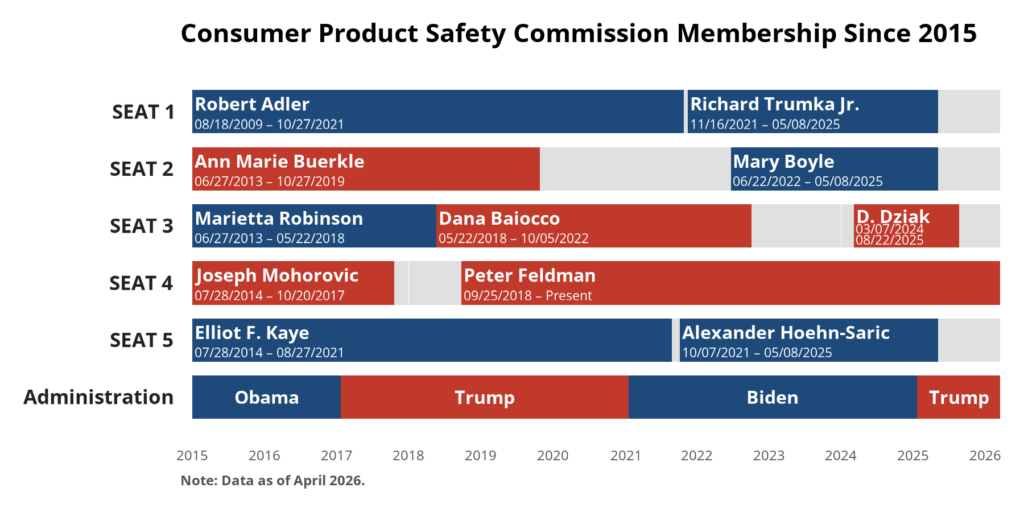
 

Trump’s removal of three Democratic commissioners in May 2025 violated the statutory for-cause protections governing the commission and existing Supreme Court precedent.[fn-4] Compositionally, those removals eliminated opposition-party representation entirely. Normatively, the administration has declined to nominate replacement members and instead allowed the commission’s structure to degrade further.

Following the resignation of one of the remaining Republican members, the commission was reduced to a single individual, acting Chairman Peter Feldman, to whom full decision-making authority has been delegated. As a result, an agency designed to operate through multi-member, bipartisan deliberation now functions under the control of one official.

Under single-member control, the commission continues to take consequential actions: releasing new safety standards, reaching settlements with corporations that knowingly failed to disclose product defects and altering its cost-benefit methodology for safety regulations in ways that reduce the value placed on the loss of children’s lives.

The CPSC demonstrates how the institutional safeguards of independence can be undone not only through formal legal change, but through the combined effects of removal, non-nomination and the abandonment of governing norms.

Conclusion

Trump’s actions toward independent boards and commissions have done more than break norms. They have materially reshaped who controls these bodies, on what basis decisions get made and whether the expert, politically insulated governance Congress designed them to provide can function at all. By arbitrarily firing members with for-cause protections, eliminating opposition-party membership on partisan-balanced bodies and abandoning the informal norms that have historically reinforced congressional intent, the administration has simultaneously attacked the legal, compositional and normative foundations of agency independence. In some cases, core government functions required by Congress are not happening at all.

The Supreme Court’s decisions in cases like Trump v. Slaughter and Trump v. Cook will determine whether for-cause protections retain their constitutional footing,but they will not resolve the full scope of the problem. Even a ruling in favor of the fired members would leave intact the broader pattern of norm erosion: the refusal to nominate Democratic members, the departure from bipartisan confirmation practices and the deliberate consolidation of these bodies under single-party control. Some of these changes are already effectively permanent, as several fired members have abandoned their legal challenges and left their positions. The result is not simply greater presidential influence over independent agencies—it is the effective transformation of multi-member, bipartisan institutions into extensions of unilateral executive authority.

These developments raise questions that extend beyond the institutions themselves. If the legal structures Congress designed to insulate independent agencies from presidential influence can be eroded through a combination of aggressive removal, strategic non-nomination and favorable court rulings, what remains of the independence these bodies were created to protect? And if independence cannot be restored, what does it mean for the expert-driven, politically insulated governance Congress sought to create—and for Americans who depend on these agencies to make consequential decisions about their safety, their finances and their rights free from political interference?

In light of these dramatic changes, Congress must increase its oversight of board and commission decisions and policymaking to ensure that these entities are carrying out their intended functions and doing so on the basis of expertise and deliberation. Congress should also engage the administration to understand their plans for future nominations and make sure they are in line with the law and Congressional interests.

Further institutional and structural reform may be necessary in the wake of the Supreme Court’s decisions to maintain the independence of boards and commissions that Congress and the American public have relied upon for over a century. Experts and organizations working to strengthen U.S. democracy and revitalize federal government operations, including the Partnership, must also take into account how much the landscape is shifting as we devise reform proposals and strategies to make government more effective, accountable and responsive.

Bob Cohen
Senior Writer and Editor

Chris Piper
Manager, Public Policy and Stakeholder Engagement

Georgeann McLemore
Associate Graphic Designer

Jenny Mattingley
Vice President, Public Policy and Stakeholder Engagement

Jessie Durrett
Director, Public Policy and Stakeholder Engagement

Kari Rea
Director, Public Policy and Stakeholder Engagement

Samantha Donaldson
Vice President, Communications