
Most Americans say changes made their lives and communities worse off

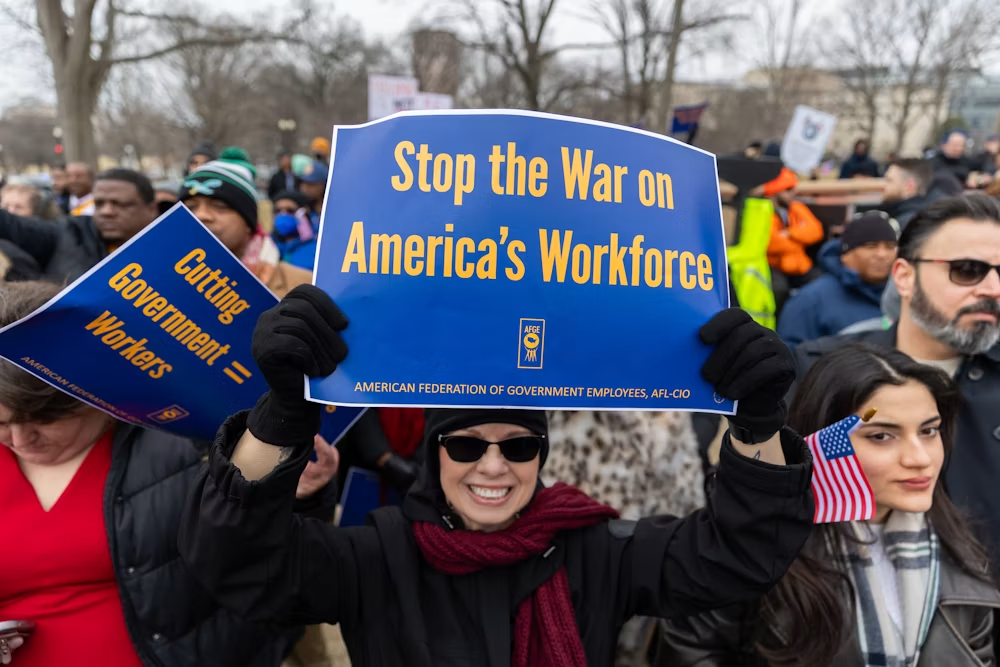
More than a year into the second Trump administration, the effort to reshape the federal government through haphazard funding cuts, workforce reductions and unilateral actions affecting programs and services is deeply unpopular among the American public.
A new survey conducted by the Partnership for Public Service finds that 52% of the public oppose the administration’s changes to the federal government compared with only 39% who are in support. Far more people say the changes have made their lives or communities worse (51%) than say they have made things better (28%). At the same time, the majority of Americans say the administration has not been effective in making the government more efficient and more people say the government is wasteful now than one year ago.
While the White House may claim to have a mandate to make dramatic cuts to the federal workforce and programs, the administration has not succeeded in convincing the public that such changes will have a positive effect on the country.
In fact, the Trump administration’s criticism of many government workers may have backfired. For several key questions in our survey, views of civil servants are at the most positive levels recorded since the Partnership began conducting yearly polling in 2021. Now, 65% of Americans say civil servants are competent, up from 57% last year. And support for a nonpartisan federal workforce has increased, despite efforts by the Trump administration to politicize many aspects of the civil service.
Even though the overall level of opposition to the administration’s efforts is similar to results from the Partnership’s survey last year, there are still many Americans who indicate they are uncertain about the ultimate consequences. About one-in-five say they do not know whether the cuts have had a positive or negative effect on their lives or communities. Even among Republicans—who mostly support these actions—there is still significant doubt as 26% say they are unsure of the overall effects. This degree of uncertainty may provide an opportunity for organizations and advocates promoting effective governance to reach a wide range of the public.
Many Americans are directly witnessing the effects of these cuts. One-in-three say that they, or someone they know, has personally been impacted. More than half say they have witnessed effects on areas such as the cost of living, while 35% say they have seen an impact on the delivery of government services such as Social Security and air travel safety.
While partisanship clearly plays a role in many people’s views on the governmental changes, supporters and opponents are sharply divided regarding the effectiveness of the changes and the view about how much direct savings will be seen by taxpayers. Overwhelmingly, supporters say the administration has been effective in making the government efficient and three-in-four believe the average taxpayer will see at least “some” savings from those efforts. By contrast, opponents do not believe the federal government has been made more efficient and very few think taxpayers will see direct benefits.
Despite claims by the Trump White House that cuts in the workforce and programs saved money for taxpayers, the actual money spent by the federal government has increased since the administration took office. In fact, the cuts have greatly harmed the economy and created new, unintended costs for the American people.
The cuts remain unpopular
 As was the case last year, most Americans oppose how the Trump administration is managing the government. Now, 52% of Americans oppose their reform efforts, compared with 39% who support and 9% who say they do not know.
The overall levels of support and opposition remained steady, as have most of the splits by partisan affiliations. Eighty-nine percent of Democrats oppose the administration’s changes, as do 12% of Republicans.
There was some movement among self-described independents. Last year, 42% said they opposed the cuts and 37% were unsure. This year, it appears that some of those who were previously uncertain have changed to a more negative view. Now, more than half of independents (56%) say they are opposed and fewer say they are unsure at 27%.
When asked about the consequences of the cuts, opposition is similarly robust. About half (51%) of Americans say the Trump administration’s layoffs and funding reductions have made their life or community “worse” compared with only 28% who say the actions have made their life or community “better.” About one-in-five answered they did not know whether the actions had made things better or worse—the same percentage as last year and an indication that a large portion of the country is uncertain about how the cuts will ultimately play out and connect to them personally.
Views of civil servants have improved despite repeated attacks by the administration

Members of the Trump administration have repeatedly criticized federal workers. Prior to taking office, the current director of the Office of Management and Budget Russell Vought said he wanted federal workers to be “increasingly viewed as the villains.”
Last March, Trump addressed the loss of jobs for federal employees by saying, “Many of them don’t work at all. Many of them never showed up to work.” Former White House adviser Alina Habba said that some military veterans affected by the layoffs may not be “fit to have a job at this moment.”
These statements, along with the haphazard nature of the layoffs, constituted an unprecedented attack on the nonpartisan civil service. However, such criticisms did not decrease the public’s views of the federal workforce. In fact, it may have had the opposite effect as civil servants received the highest level of support since the Partnership started conducting yearly surveys in 2021.
Now, 61% of Americans agree that civil servants “are committed to helping people like me,” up slightly from 56% last year. Even among Republicans, that view increased from last year from 52% to 63%.
In fact, the view that civil servants are committed workers has risen each of the last four years the Partnership has conducted surveys. In 2022, 46% of the public agreed with that notion—15 percentage points lower than it is now.
The view that most civil servants are competent also increased. Now, almost two-thirds of Americans agree with that notion, up from 57% one year ago. While this increase was true for Republicans, it was especially true among independents where now, 51% agree that most are competent up from 32% last year.
Where Americans are witnessing the impact of cuts

The federal funding and workforce cuts have impacted communities across the country and in areas ranging from education to safety to public health. According to this most recent survey, one-in-three Americans say they—or someone they know—has personally been impacted by the administration’s cuts.
More than half (53%) say they have seen the cuts to the government impact inflation and the cost of living. This is likely due to the fact that at the time of the survey, the issue of inflation was by far the greatest concern for Americans.
More than a third of the public believe they have witnessed an impact on the delivery of benefits and services such as Social Security, Medicare, veterans’ healthcare and tax assistance (35%). This aligns with news reports and public data showing that staff cutbacks at the Social Security Administration dramatically increased wait times for callers and cuts to the Department of Veterans Affairs have increased backlogs for veterans to receive health care and ended important research studies.
The same number of people (35%) say they noticed how government cuts impacted air traffic safety and air traffic control. The survey was conducted during a partial government shutdown of the Department of Homeland Security that created a shortage of Transportation Security Administration officers, leading to hours-long waits for passengers at some airports.
What is behind the public’s views?

Supporters and opponents of the Trump administration’s reforms agree on a few key issues. At nearly the same rate, both groups see the government as wasteful, both see the value of a nonpartisan civil service and both tend to say that civil servants are competent.
There is large disagreement, however, regarding the effectiveness of the Trump administration’s efforts and the right of a president to staff the federal workforce. Supporters also carry a strong belief that the cuts to government will result in savings for the average taxpayer.
Conclusion

The results of the Partnership’s research show that Trump’s haphazard and unilateral workforce and funding reductions are deeply unpopular, and the administration is out of step with the views of most of the public. There is a widespread belief that the cutbacks have had a negative impact on the lives of Americans. Furthermore, the public’s positive views of civil servants have increased over the past year, as has the perceived importance of a nonpartisan federal workforce.
After decades of growing distrust in government, however, these findings reinforce a general dissatisfaction with government and a need for comprehensive reform. As the country celebrates its 250th anniversary this summer, we have an opportunity to lay out a new path to make government work better and to consider how positive civic action can help create a better government while also addressing concerns regarding efficiency and costs.
The Partnership for Public Service is looking to help define the path forward in two major ways. First, the Partnership is marking the 250th anniversary by promoting civic engagement and conversations about the future of the federal government. Second, the Partnership’s Government for a New Era initiative is focused on developing ideas and plans to improve government in the coming years.
These collaborative efforts with policymakers, practitioners, stakeholder groups and members of the public are aimed at advancing bold, forward-looking improvements to make the government more effective, responsive and accountable.