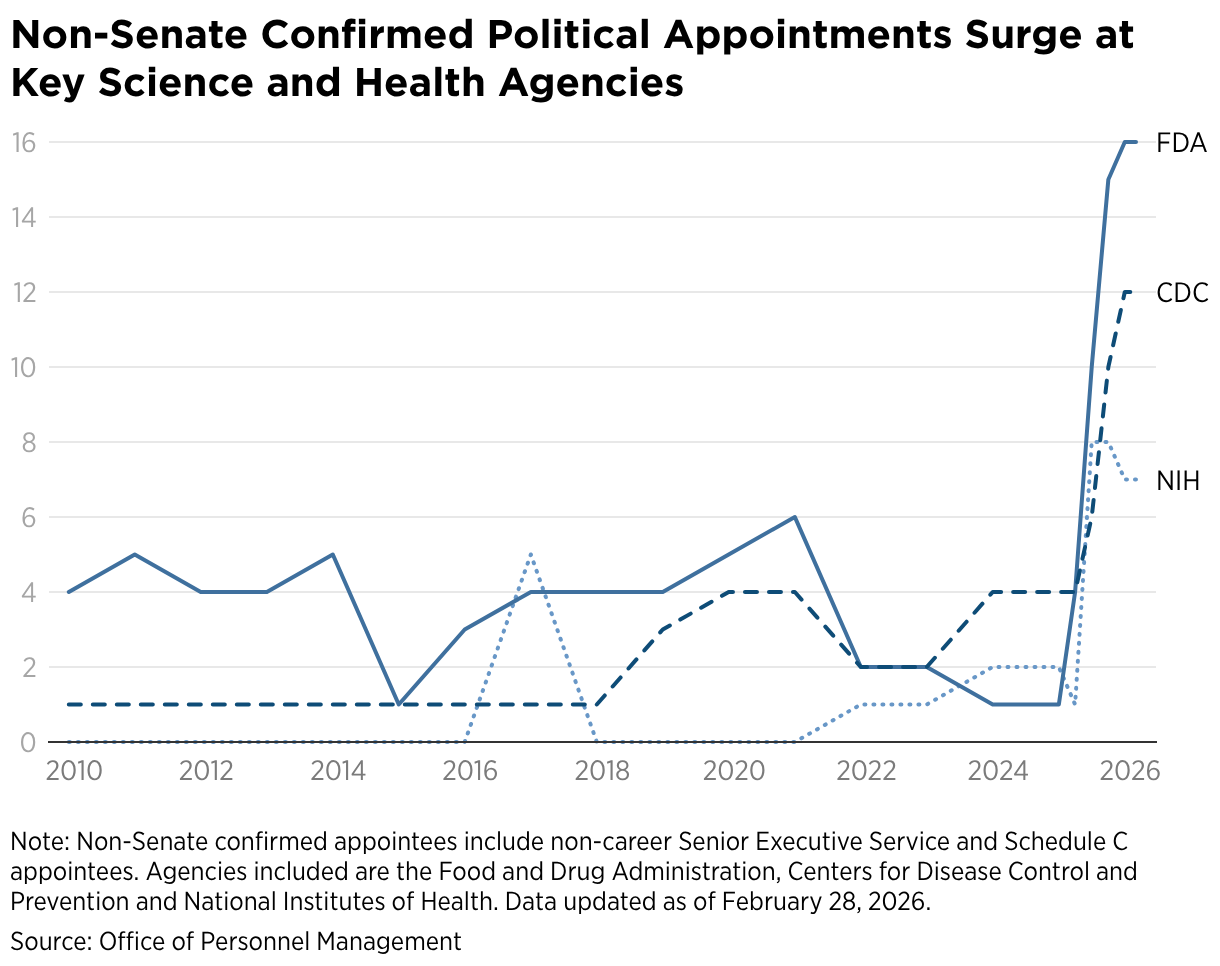
The federal agencies that monitor disease outbreaks, ensure food safety, protect the environment and fund the nation’s scientific research have lost career senior leadership at disproportionately high rates—while seeing political appointments surge to levels with no modern precedent.
The federal government now has the largest political workforce in at least 40 years and the smallest career senior leadership in at least 25 years, according to our recent report.
Environmental, health, and science agencies are in many cases driving this trend.
These agencies share a common characteristic that has made them particular targets: Their core functions depend on scientific integrity and the professional judgment of experienced career leaders. The current administration has sidelined expert advisors without cause or reason, haphazardly restructured agencies, and arbitrarily targeted grants and programs, sometimes in the name of eliminating anything related to diversity, equity and inclusion.
The result is not a leadership vacuum so much as a deliberate substitution—career officials whose expertise has historically kept policy tethered to evidence, replaced by appointees selected outside any competitive or confirmation process. This substitution threatens public health, economic competitiveness and scientific innovation that American communities and industries depend on.
The dismantling of career leadership
The decline in career Senior Executive Service leaders across environmental, health and science agencies has been severe—in several cases far exceeding the government-wide average of nearly 30%.
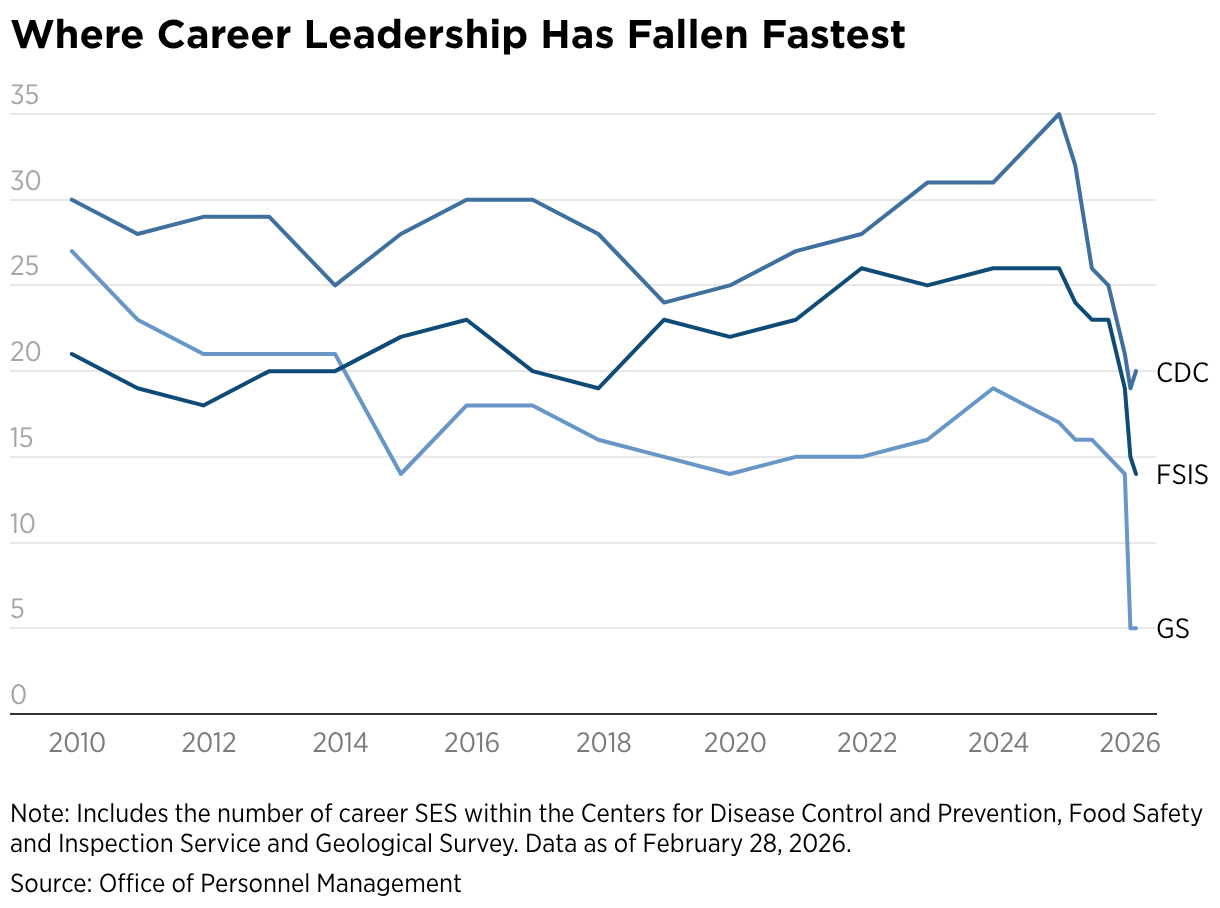
The Geological Survey within the Department of the Interior has lost 70.6% of its career SES since December 2024, gutting the agency that provides the scientific foundation for land use, water management, natural hazard assessment and agricultural planning, with downstream consequences for farmers, insurers and builders.
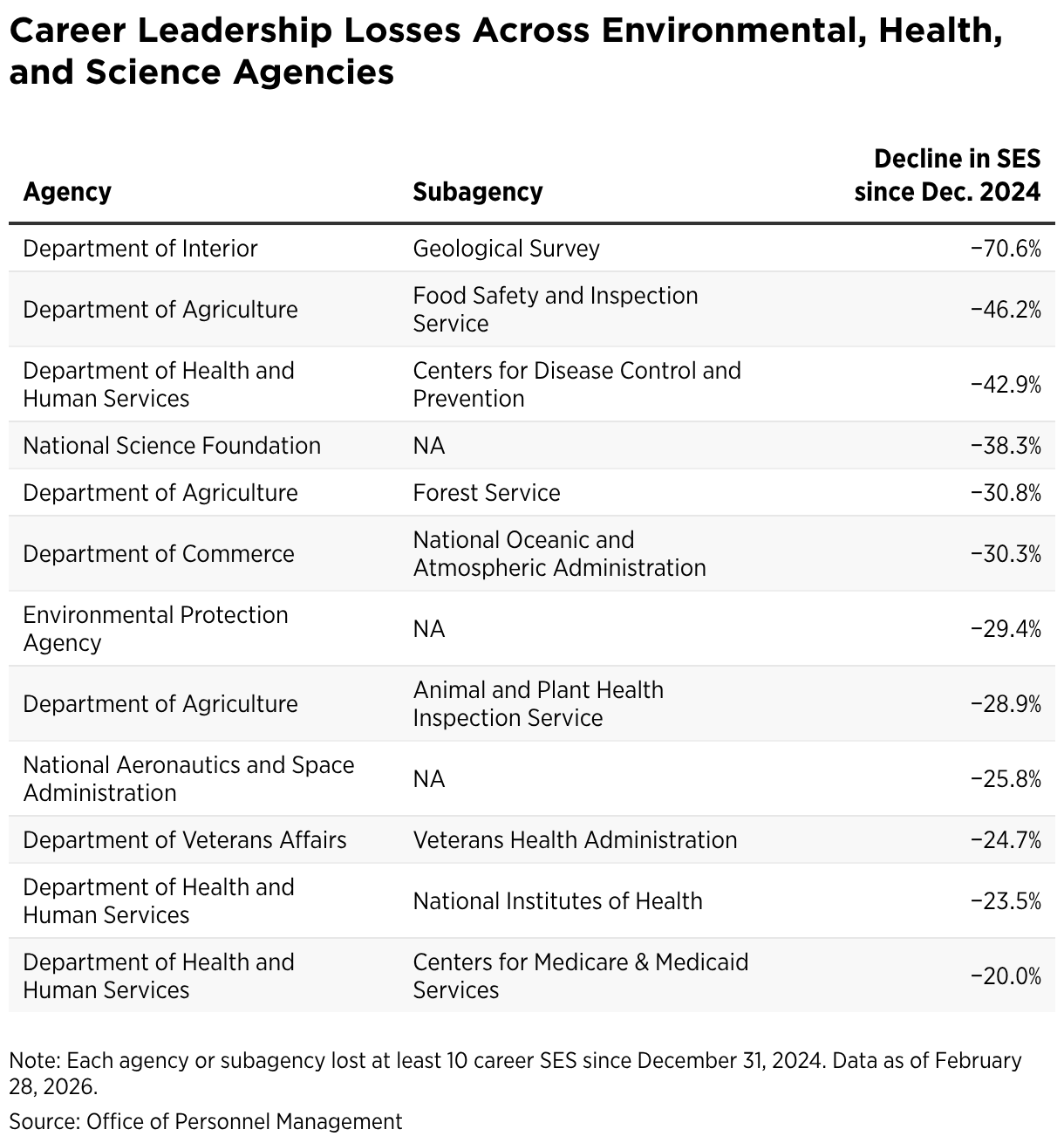
At the Centers for Disease Control and Prevention, career SES losses of 42.9% have left 80% of top director positions vacant, with no permanent leadership to coordinate the agency’s core work on infectious disease, cardiovascular health or cancer screening. Career officials claim productivity is slowing due to bureaucratic delays.
“I fear the experience, leadership and need for decisive action just won’t be there, said Daniel Jernigan, the former director of the CDC’s National Center for Emerging and Zoonotic Infectious Diseases, when discussing the agency’s response to a future pandemic. This kind of institutional knowledge and leadership capacity cannot be rebuilt overnight.
In addition, the Veterans Health Administration lost 24.7% of its career SES—including several executive directors of VA medical centers. This loss of leadership capacity, in addition to 90% of VA facilities reporting severe physician shortages, compounds a crisis that predates the current administration.
Political control without precedent
In many cases, the agencies losing the most career leaders are the same ones gaining the most non-Senate confirmed political appointments. The result is a dramatically higher concentration of decision-making authority in appointees selected outside any competitive or confirmation process.
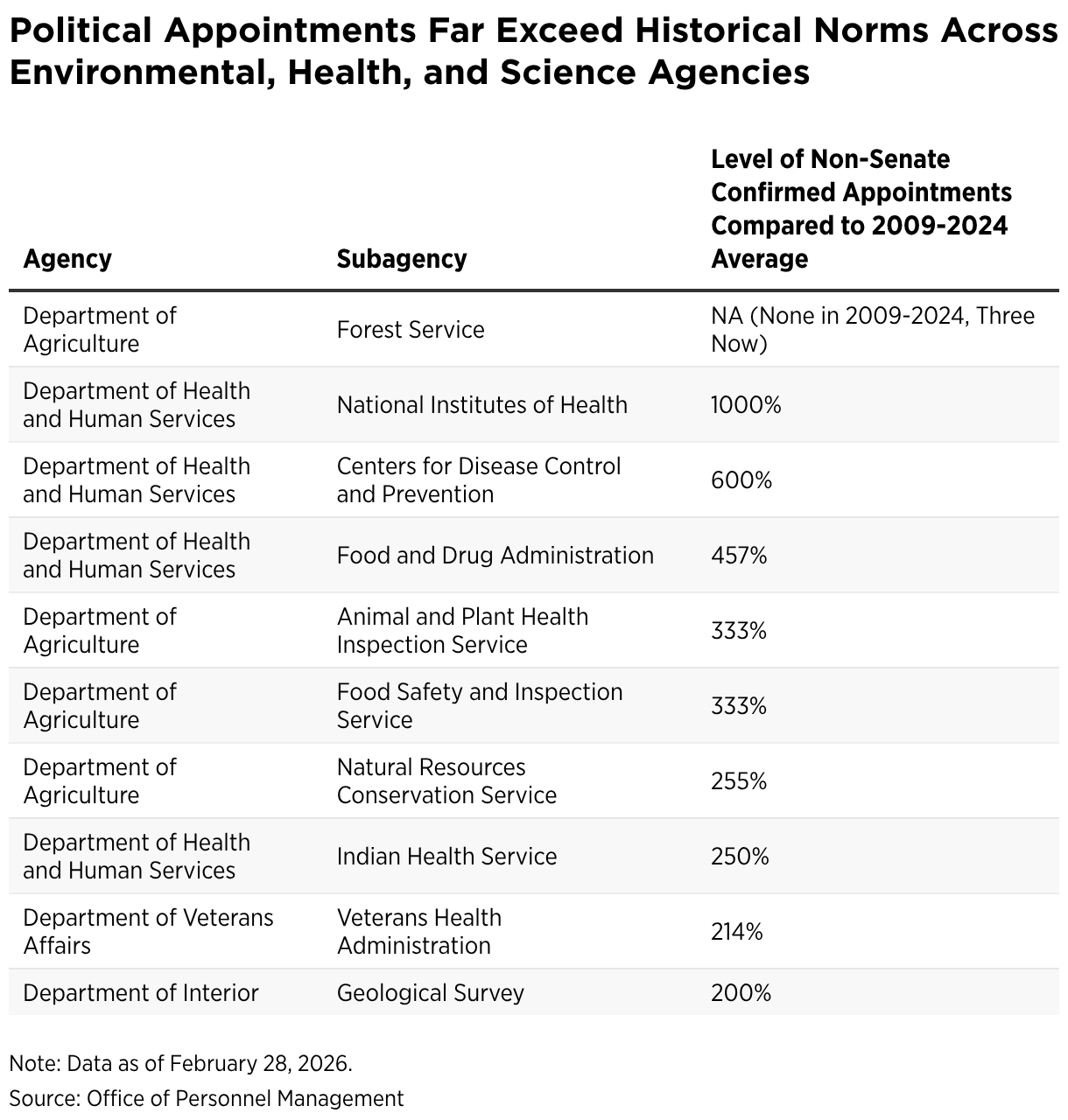
For much of 2009-2021, the National Institutes of Health had no non-Senate confirmed appointees. It now has seven.
The result has been unprecedented political scrutiny over research funding decisions that career officials have historically managed based on merit and evidence. Grant proposals are now vetted for ideologically disfavored terms, and spending on new medical research has fallen roughly $1 billion behind prior years.
At the CDC, the pattern is similar. From 2009 to 2018, the agency had a single non-Senate confirmed appointee. It now has 12.
This influx of political staff has led to direct interventions in the agency’s scientific work. Political appointees have moved to exert control over the Morbidity and Mortality Weekly Report—the CDC’s flagship medical research publication—dictating coverage priorities, withholding studies on the bird flu outbreak and the COVID-19 vaccine, and ending a decades-long tradition of editorial independence for the journal.
The Food and Drug Administration has engaged in similar interference, directing staff scientists to withdraw peer-reviewed studies that found no significant safety concerns for COVID-19 and shingles vaccines.