

President Trump’s June 3 executive order strips civil service protections from more than 4,800 positions, making the employees who occupy them fireable at-will, the latest step in a sustained effort to politicize the federal workforce and consolidate control over the executive branch.
Many of the converted employees manage the legal, personnel and budget functions agencies depend on to operate: the attorneys who determine whether agency actions are legal, the specialists who manage hiring and personnel, and the officers who execute agency budgets. The order also reaches the career staff of independent boards and commissions, entities Congress deliberately structured to be insulated from presidential control.
Senior career leadership has already thinned dramatically across the federal government. These conversions reach the layer just beneath those positions, making at-will removal an available tool of political control over the officials who staff agencies day to day. Our analysis of the order’s appendix shows where that control is being extended.
President Trump issued an executive order on Inauguration Day 2025 that created Schedule Policy/Career, and the Office of Personnel Management finalized the implementing regulation in March. The June 3 order puts the new schedule into effect, moving the first tranche of positions into Schedule Policy/Career.
The research on at-will employment in the public sector is clear: It does not improve employee or agency performance, and it heightens the risk of politicized firings, silenced dissent and higher turnover. These are the defining features of a spoils system. The analysis below shows where that system is taking hold.
Conversions hit bureaus already losing career leaders
The Schedule P/C conversions deepen a historic contraction of career leadership.
As we documented in our report on the politicization of federal leadership, the career Senior Executive Service has contracted by nearly 30% since the end of 2024, the smallest career senior leadership in at least 25 years, even as the administration installed record numbers of political appointees.
The five agencies with the greatest number of Schedule P/C reclassifications are the departments of Defense, Homeland Security, Health and Human Services, Treasury and Commerce. The Defense Department alone accounts for 1,608 positions in the executive order’s appendix, roughly a third of all positions listed.
Department-level totals, however, obscure where the conversions actually land. Outside the Defense Department, the bureau-level data shows the transfers concentrated in components responsible for immigration services, public health, cyber defense and disaster response. In many cases, these bureaus are the same ones that have lost the largest shares of their career SES.
This overlap is not uniform. The Office of the Comptroller of the Currency had 95 positions transferred with no decline in career SES.
All figures in the table below count positions, not employees. Multiple employees can serve in a single listed position, and the appearance of a job title in the appendix does not mean every employee holding that title was converted. The appendix does not say how many employees each position covers, a glaring gap in transparency addressed later in this post.

Nevertheless, the pattern is starkest for bureaus already strained by departures of career leadership:
- The Centers for Disease Control and Prevention, where career SES losses near 46% have left 80% of top director positions vacant, had 94 positions converted to Schedule P/C.
- The Cybersecurity and Infrastructure Security Agency, which has lost more than half its career SES at a moment of escalating cyber threats, had 52 positions converted.
- The Federal Emergency Management Agency, down 34% as disaster season begins, had 50 positions converted.
In each case, the order strips protections from the most senior career officials below the SES who remain. These positions are being converted just as the leadership above them has emptied out.
The new schedule reaches independent boards and commissions
The conversions also reach independent boards and commissions, institutions Congress designed to have statutory guardrails against executive overreach. The executive order appendix lists 452 positions across 13 of these bodies.

The administration has spent the past year consolidating authority over these boards and commissions—firing or attempting to fire 20 members with for-cause removal protections and removing 16 Democratic members from partisan-balanced bodies, leaving nearly 40% of them with no Democratic membership. The administration has also placed non-Senate-confirmed political appointees at the Federal Labor Relations Authority and the Nuclear Regulatory Commission for the first time.
Converting career staff extends this campaign from the commissioners into the workforce that operates these bodies day to day. A Federal Communications Commission attorney or Federal Energy Regulatory Commission analyst who can be removed at-will, without explanation or appeal, operates under a form of political pressure Congress designed these institutions to be insulated from.
Attorneys, human resources and budget staff: Positions far from policymaking
The executive order justified the new schedule as covering positions of a “policy-influencing” character.
The position-level data tests that rationale. Three categories stand out: attorneys, HR officials, and budget and financial management staff. These are not conventional policymaking roles. They are the legal, personnel and financial control functions that ensure agencies operate lawfully and responsibly for the benefit of taxpayers.
Making these positions at-will does little to advance policy responsiveness, but rather extends political control over the people who manage agency operations and advise on what the law allows.
Attorneys
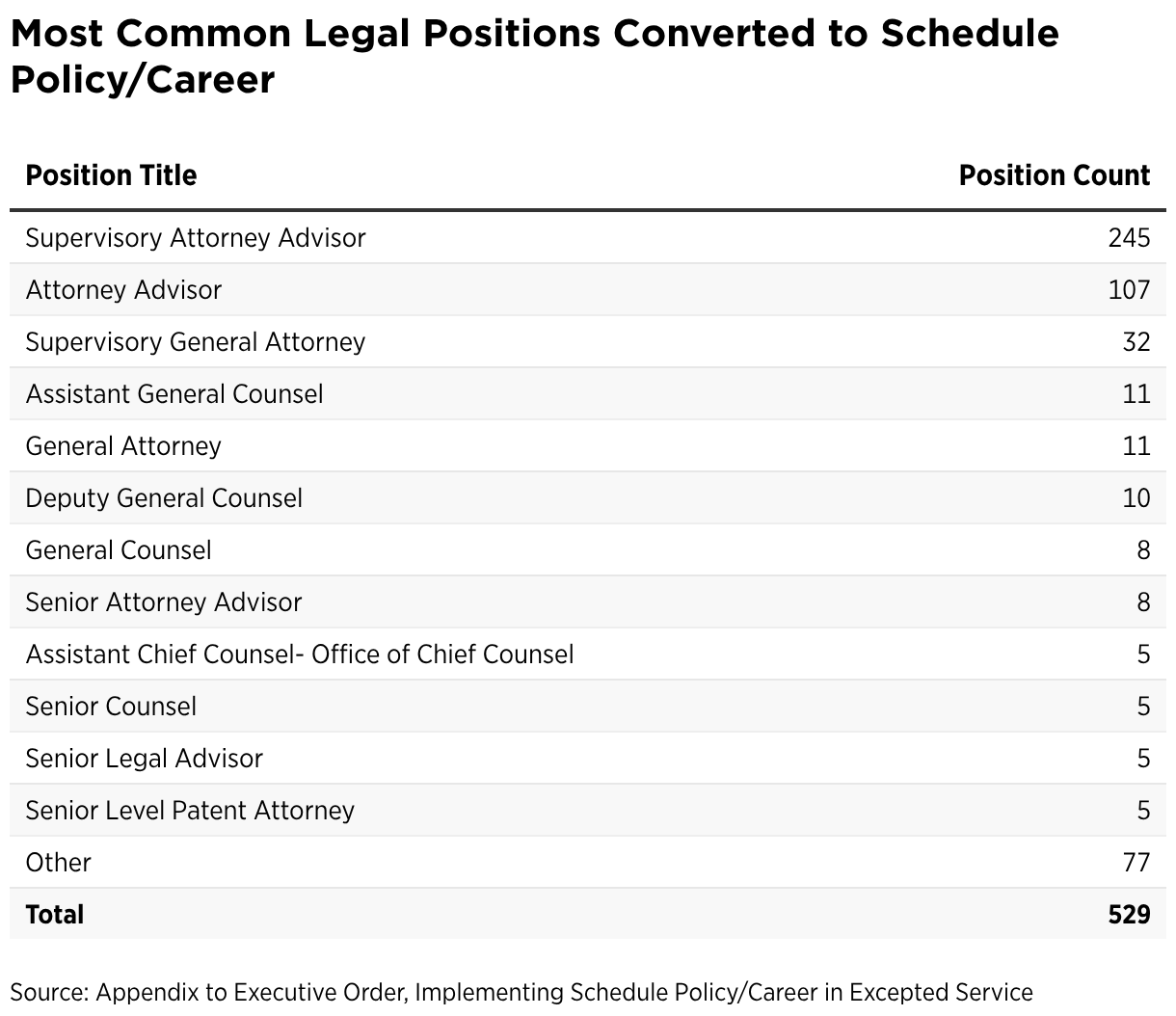
At least 529 legal positions have been converted, including 245 supervisory attorney advisors, 107 attorney advisors and the senior ranks of agency counsel offices: deputy general counsels, assistant general counsels and general counsels themselves.
Prior research has shown that removing protections can force employees to choose between complying with political directives or facing termination. Without protections from arbitrary removal, the incentive for an attorney may shift from giving a factual legal answer to giving the one leadership prefers. It also may discourage attorneys from documenting policy discussions and legal advice, thus minimizing any record of what is actually taking place and reducing transparency and accountability to the public or to Congress.
Human resources
At least 288 HR and human capital positions have been converted, led by 138 supervisory human resources specialists, along with HR directors and chief human capital officers.
HR officials process adverse actions the new schedule enables. An administration that has already exerted unprecedented control over hiring, performance standards and firings now gains at-will leverage over the officials who carry out these actions, removing a potential internal check on improper personnel practices.

Budget and financial management
At least 342 budget and finance positions have been converted, including 65 supervisory budget analysts, 32 budget officers and six chief financial officers. These officials execute appropriated funds and maintain financial controls.
The administration has already repeatedly moved to withhold funds Congress has appropriated, and budget officials are the career staff who execute appropriations law. An official who can be removed at-will faces obvious pressure when asked to withhold funds that the law may not permit.

Together, these three categories account for more than 1,100 of the converted positions, in functions with a tangential connection to policymaking at best.
This pattern suggests the schedule is operating less as a tool to increase the workforce’s responsiveness to presidential policy preferences and more as a mechanism for extending political control over the management of federal agencies. This approach creates many risks, including increasing the likelihood that basic government functions will be pulled in different directions under different administrations and that personnel may feel increased pressure to comply with political directives that undermine the law and best practice.
The administration says the Senior Executive Service is excluded. The executive order’s appendix makes that hard to verify.
OPM’s implementation guidance states that the new schedule does not reach the Senior Executive Service. Yet matching the executive order’s appendix against the 2025 Plum Book on agency, subagency and position title identifies at least nine positions that also correspond to career SES positions.
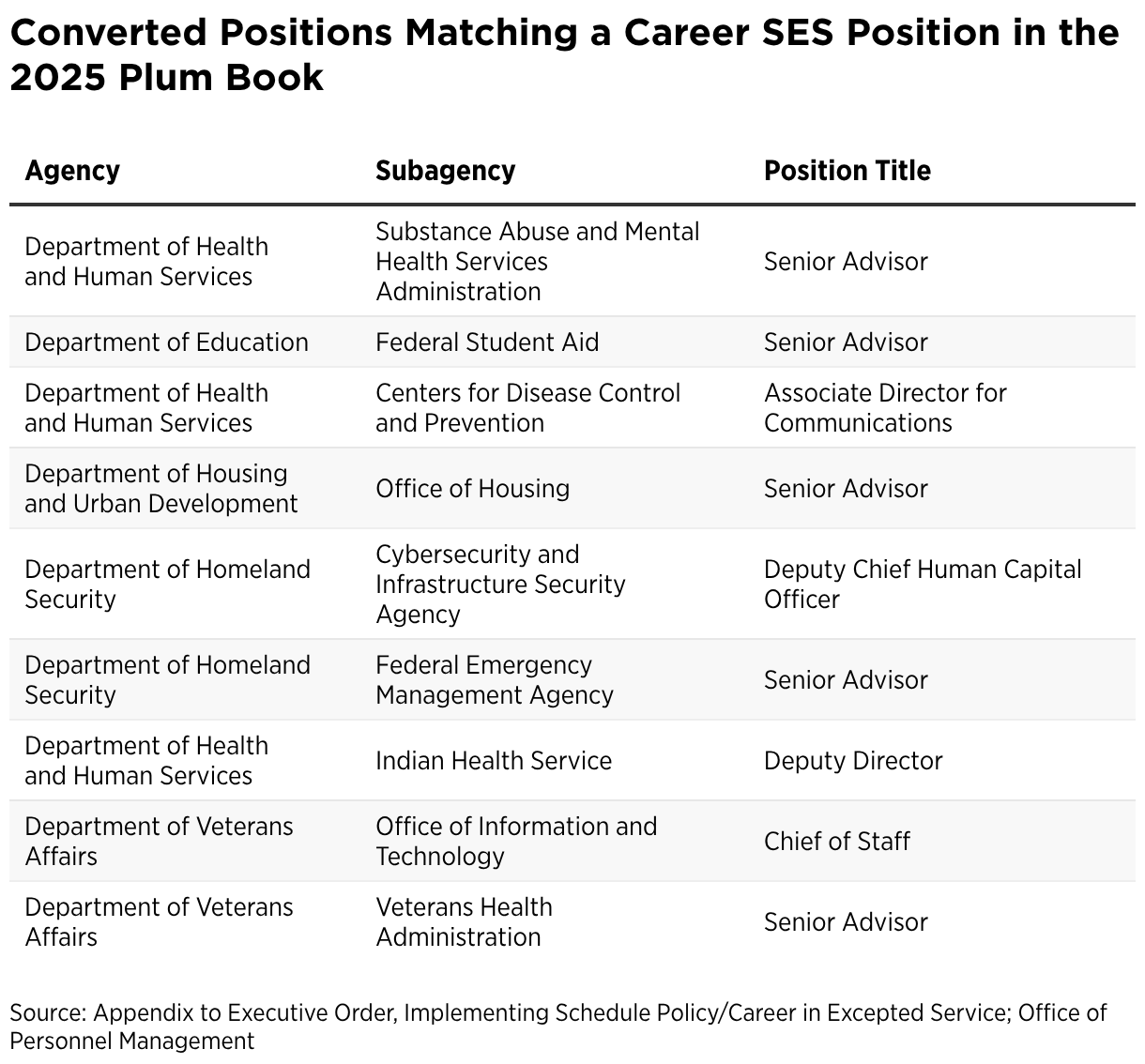
Some of these matches are easier to dismiss than others. “Senior Advisor,” which accounts for five of the nine, is a generic title that exists across grade levels and appointment types, so an appendix entry sharing that title with a career SES position at the same agency may be coincidence rather than the same job.
The others are harder to explain away. Titles like deputy chief human capital officer, associate director for communications, deputy director and chief of staff are specific and tied closely enough to a particular office. So, a match on agency, subagency and title is difficult to read as anything but a position that looks like career SES.
However, the appendix’s missing grade and series data make any firm conclusion difficult, if not impossible. Ultimately, we lack sufficient information to know whether the administration’s claim about excluding career SES members from Schedule P/C conversions is true.
A fundamental change, thinly documented
Evidence suggests that states that adopt at-will employment show no performance gains and clear risks of politicized firings, suppressed dissent and a shrinking talent pool.
The reclassification data shows where those risks are materializing: conversions concentrated in bureaus that have already lost a third or more of their senior career leaders, reaching into independent regulators and covering thousands of career officials, including the attorneys, HR specialists and budget officers whose jobs depend on expertise and stability rather than political alignment.
The executive order’s appendix omits basic information needed to understand these changes. The document lists position titles with agency identifiers and nothing more: no total count, no number of employees serving in each position, and none of the grade or series identifiers that would settle questions like the one above. A change of this scale to the civil service warrants disclosure that provides more information to Congress and the public.
The first spoils system produced a corrupt, ineffective government staffed by loyalists rather than experts. The June 3 order strips the merit protections that replaced this system from around 8,000 career employees across government. The full consequences of this action may take years to see, but they will certainly be felt far beyond this administration.